What is Inverse Tangent? A Complete Guide
Learn what inverse tangent (arctan) is, how it works, and how to calculate it. A complete guide to the arctangent function with examples.
The Basics of Inverse Trigonometry
Trigonometry is the study of triangles and the relationships between their sides and angles. While standard trigonometric functions (like sine, cosine, and tangent) help you find the ratio of sides when you know an angle, inverse trigonometric functions do the exact opposite.
If you’ve ever found yourself knowing the lengths of a triangle’s sides but missing the angle, the inverse tangent function is exactly what you need.
What Exactly is Inverse Tangent?
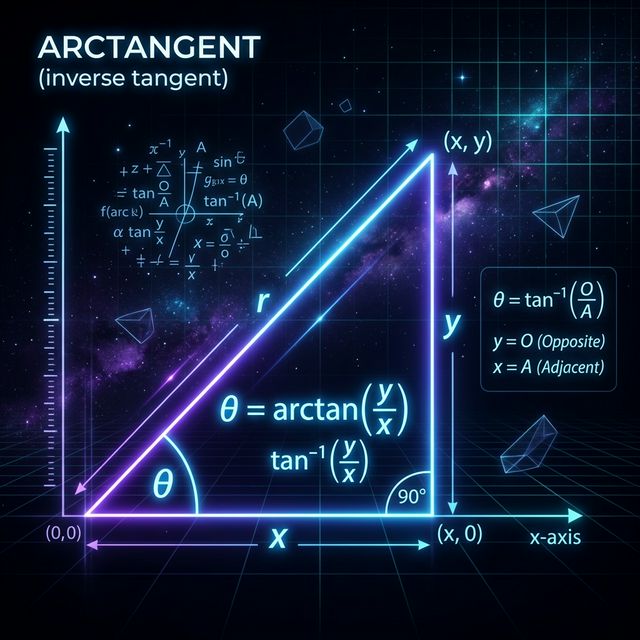
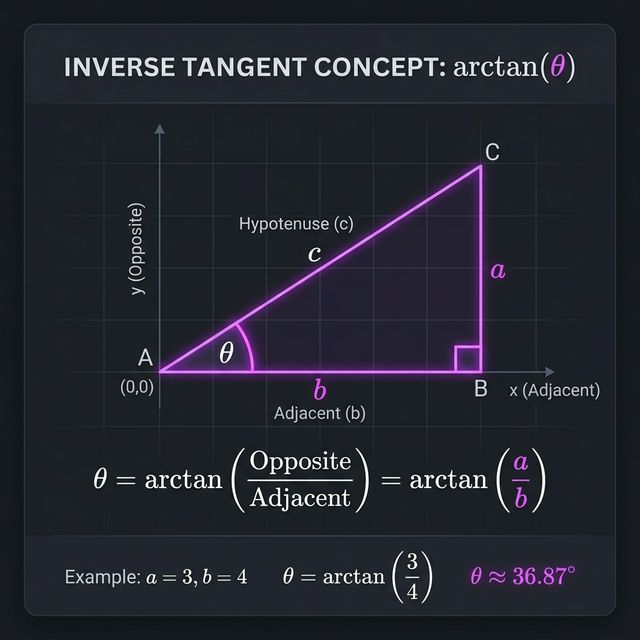
The inverse tangent function is a mathematical tool that takes a ratio (specifically, the ratio of the opposite side to the adjacent side in a right triangle) and returns the corresponding angle.
Mathematical Notation
You will typically see the inverse tangent written in one of three ways:
- arctan(x): The most common notation in advanced mathematics and calculus.
- tan⁻¹(x): The standard notation found on physical calculators and in high school geometry.
- atan(x): The notation predominantly used in programming languages (like Python, JavaScript, and C++).
Important Note: The superscript
⁻¹intan⁻¹(x)does not mean the reciprocal1 / tan(x). The reciprocal of tangent is actually cotangent. The⁻¹strictly denotes an inverse function.
Interactive Video Guide
For a highly visual and comprehensive breakdown of how to use inverse tangent, watch this excellent explanation video below:
How Inverse Tangent Works in Practice
To understand how it works, let’s look at a standard right-angled triangle:
- Tangent: You know the angle θ, and you want the ratio.
tan(θ) = Opposite / Adjacent - Inverse Tangent: You know the Opposite and Adjacent lengths, but you need angle θ.
θ = arctan(Opposite / Adjacent)
A Quick Example
Imagine a right triangle where the side opposite to your angle is 10 meters long, and the adjacent side is also 10 meters long.
- The ratio is
10 / 10 = 1. - We then ask: What angle produces a tangent of 1?
- The calculation
arctan(1)returns 45° (or π/4 radians).
Domain and Range of Arctangent
Understanding the limits of mathematical functions is crucial for avoiding calculation errors.
The Domain (Input)
The domain of arctan(x) is essentially boundless. It accepts all real numbers, from −∞ to +∞. This is because a triangle’s opposite side can be infinitely larger or smaller than its adjacent side.
The Range (Output)
The range is restricted to a specific interval known as the principal value.
- In Degrees: Between −90° and +90°
- In Radians: Between −π/2 and +π/2
Because tangent is a periodic function (it repeats its values infinitely), the inverse tangent must be restricted to this single range to ensure it acts as a proper one-to-one function.
Common Arctangent Values
Memorizing a few key values can drastically speed up manual calculations and estimations:
| Input (x) | Angle Output (Degrees) | Angle Output (Radians) |
|---|---|---|
| 0 | 0° | 0 |
| 0.577 (1/√3) | 30° | π/6 |
| 1 | 45° | π/4 |
| 1.732 (√3) | 60° | π/3 |
| −1 | −45° | −π/4 |
Manual Calculation Methods
While most people use our Inverse Tangent Calculator today, historically, mathematicians relied on manual methods:
- Taylor Series Expansion: A calculus method for approximating values.
arctan(x) = x − x³/3 + x⁵/5 − x⁷/7 + ...(Valid only for x between -1 and 1) - Trigonometry Tables: Looking up the ratio in giant, pre-calculated printed tables.
- CORDIC Algorithm: The modern bit-shift and addition algorithm that powers your digital calculator’s circuitry today.
Summary
The inverse tangent is an indispensable mathematical operation that bridges the gap between linear measurements and angular geometry. Whether you are solving a basic homework problem or writing a 3D graphics rendering engine, understanding arctan(x) is a fundamental requirement.